写此系列博客的榜样来自:leetcode cookbook
思考方式
萌新三步:思考回溯怎么写;改成记忆化搜索;1:1翻译成递推。
以下以打家劫舍为例,说明思考方式
-
回溯:
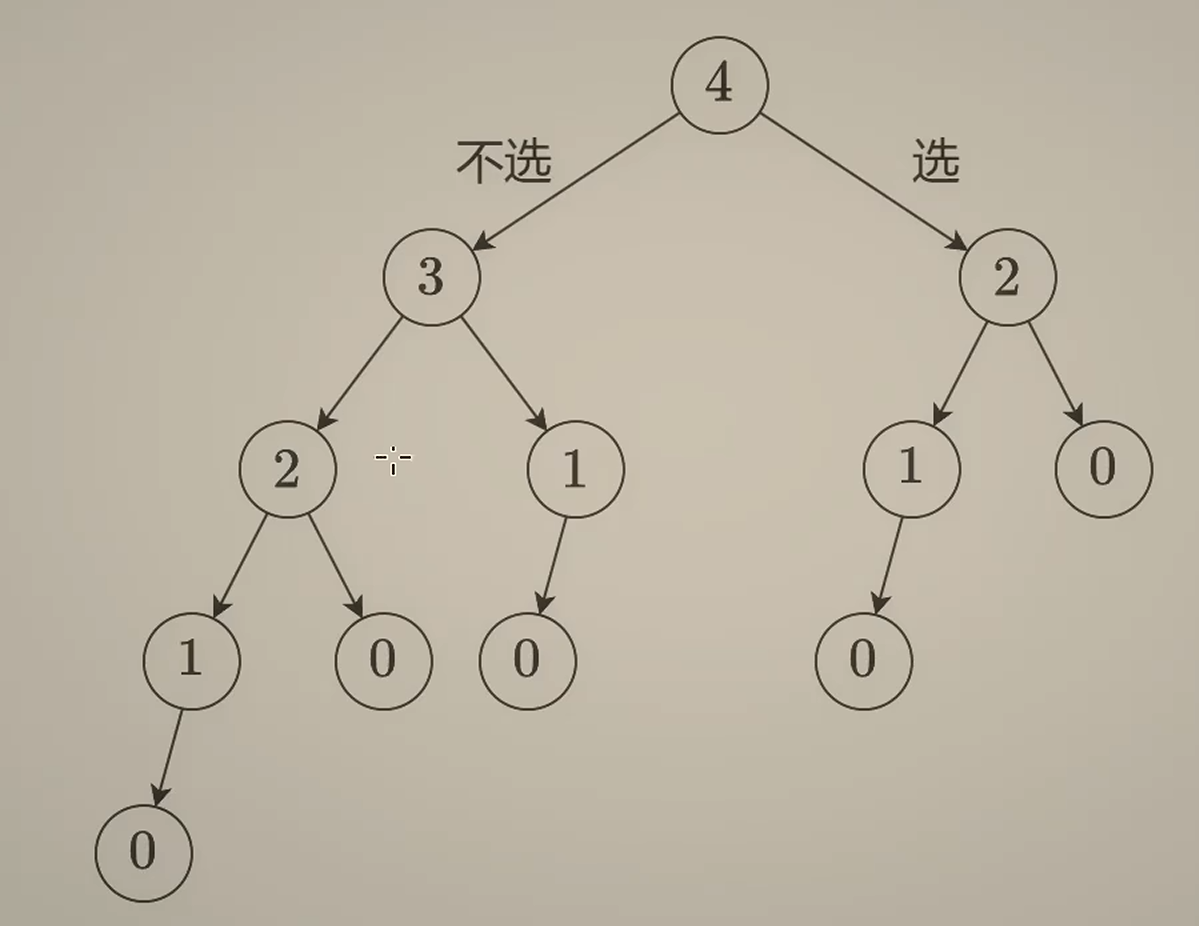
-
把递归的计算结果保存下来,
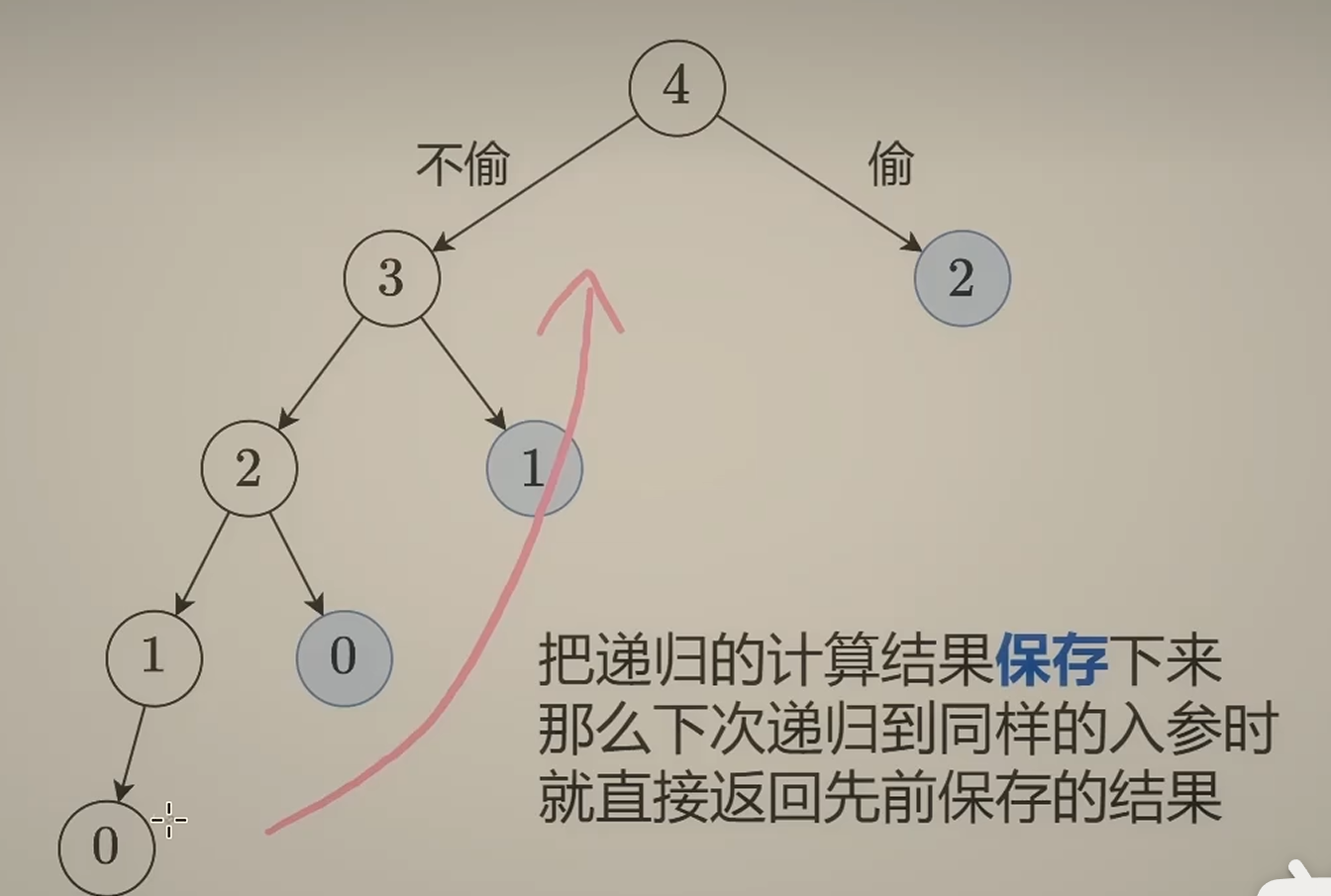
def rob():
    n=len(nums)
    cache=[-1]*n
    def dfs(i):
        if i<0:
            return 0
        if cache[i]!=-1:
            return cache[i]
        res=max(dfs(i-1),dfs(i-2)+nums[i])
        cache[i]=res
        return res
    return dfs(n-1)
- 改为递推
自底向上计算
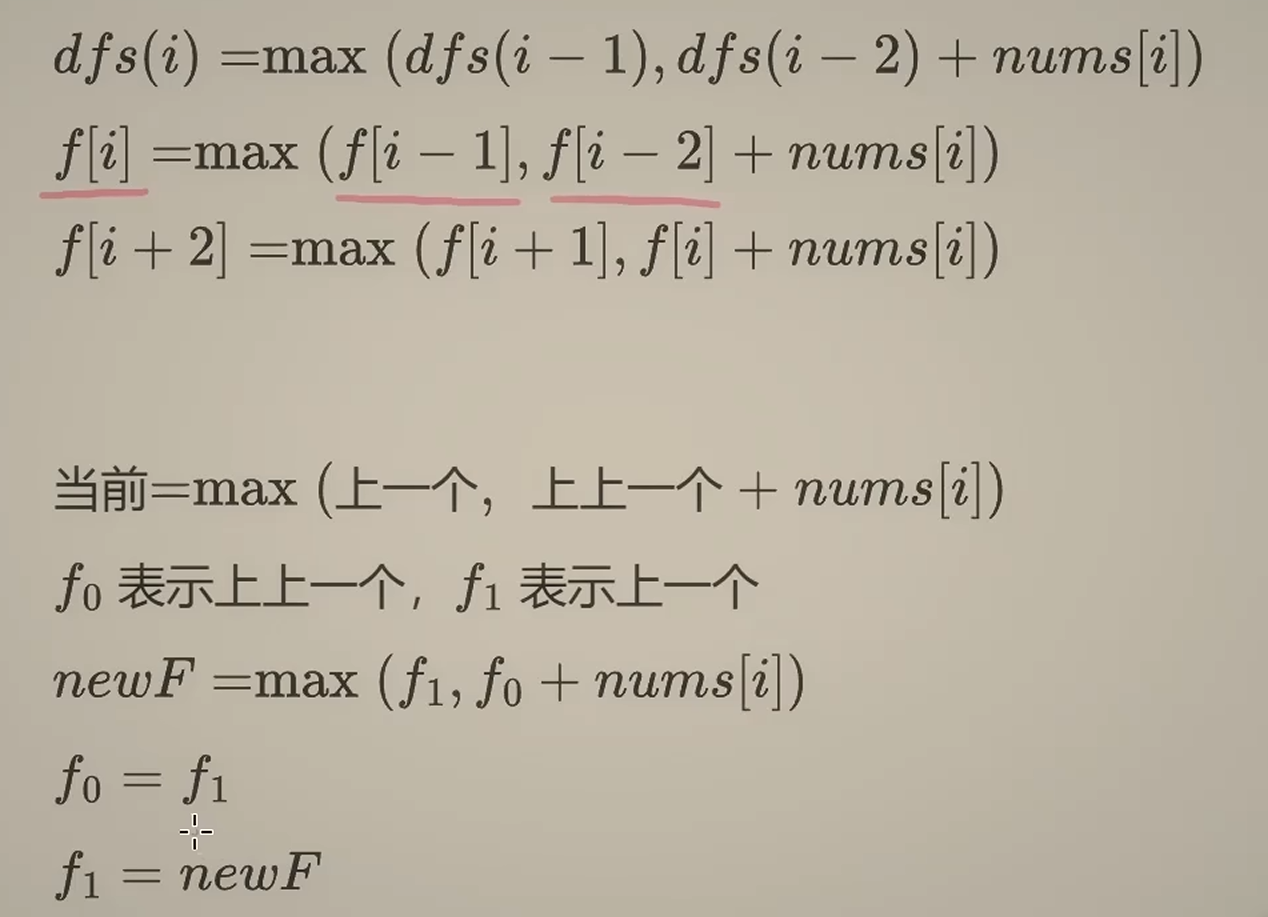
def rob():
    n=len(nums)
    f=[0]*(n+2)
    for i,x in enumerate(nums):
        f[i+2]=max(f[i+1],f[i]+x)
空间优化:
背包问题
一般问题
我们有 $n$ 件物品和一个容量(capacity)为 $C$ 的背包,记第 $i$ 件物品的重量(weight)为 $w_i$,价值(value)为 $v_i$,求将哪些物品装入背包可使价值总和最大。
0-1 背包
如果限定每件物品最多只能选取 $1$ 次(即 $0$ 或 $1$ 次),则问题称为 0-1 背包问题。
完全背包
如果每件物品最多可以选取无限次,则问题称为 完全背包问题。
假设放入背包中的物品 $i$ 的数目为 $k_i$,则上述背包问题在数学上可表达为:
\[\max \sum_{i=0}^{n-1} k_i \cdot v_i\]约束条件(subject to, s.t.):
\[\sum_{i=0}^{n-1} k_i \cdot w_i \le C\]并且:
\[\begin{cases} k_i \in \{0,1\} & \text{0-1 背包问题} \\\\ k_i \in \{0,1,2,\dots,+\infty\} & \text{完全背包问题} \end{cases}\]